The Ultimate Job Ready Data Science Course
About Course
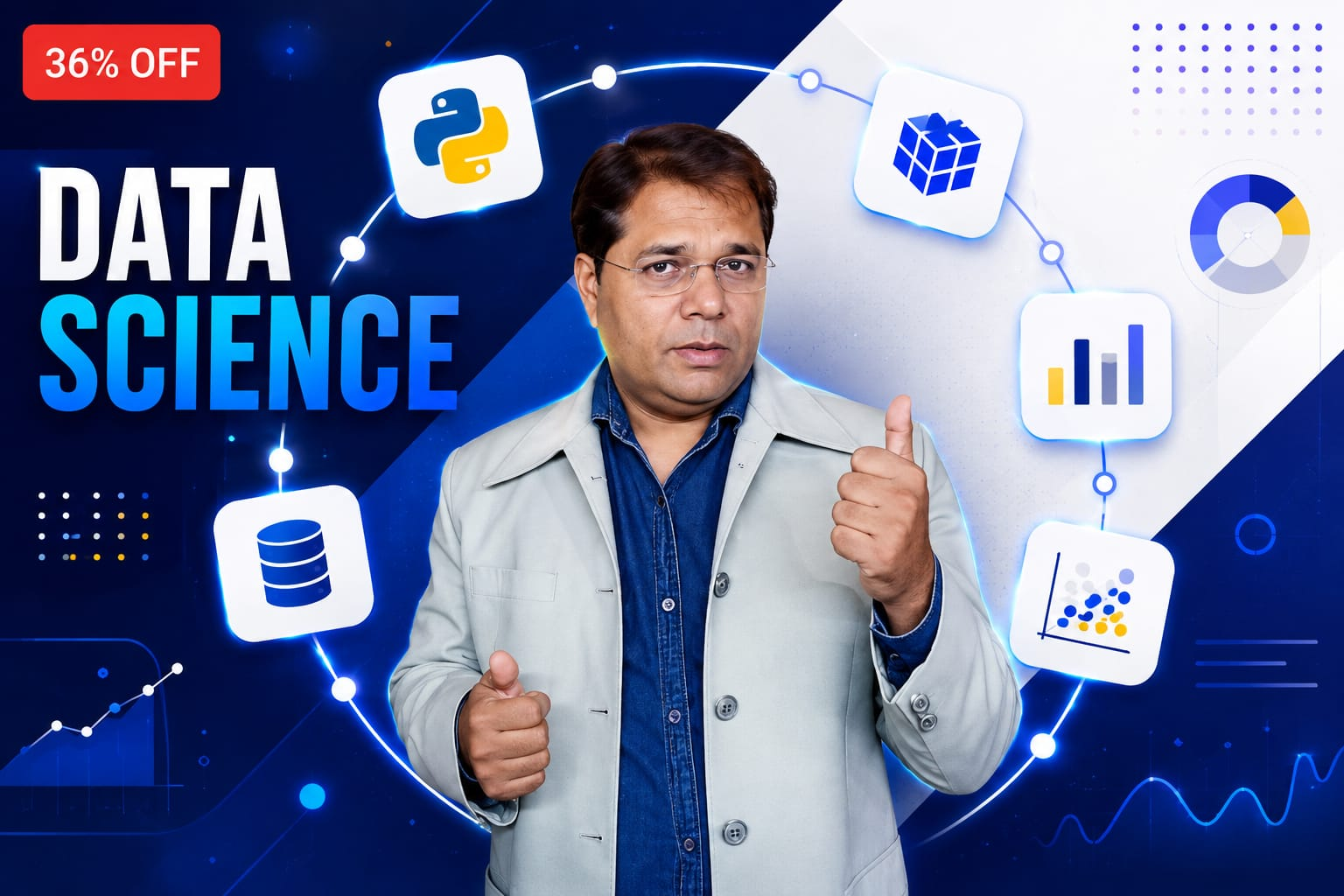
This is a to-the-point, ShamsulX style Data Science course! This all-in-one Job-Ready Data Science Course is designed for beginners and intermediate learners who want to master data science skills and become industry-ready with hands-on experience.
What Will You Learn?
- Master Python programming from a data science perspective
- Create stunning data visualizations with Matplotlib and Seaborn
- Clean and preprocess real-world datasets for accurate insights
- Use Jupyter Notebooks for data-driven development
- Perform powerful data analysis using Pandas and NumPy
- Understand and apply core statistics and probability concepts
- Work on real-life projects
- Many Developer Tools like Quadratic AI (Free with this course)
Course Content
Introduction to Data Science
-
What is Data Science
-
How to Download the Handbook
-
The Data Science Lifecycle
-
Data Science Tools: VS Code, Jupyter, Pycharm & More
Understand the Conda Environment
-
Installing Conda
-
What is Anaconda | Anaconda vs Miniconda
-
Adding Conda to Environment Variables
-
Understanding Conda Workflow
-
Anaconda Navigator: Quick Tour
-
Jupyterlab and Jupyter notebook Tutorial
Python Refresher ( for data Science)
-
Why Choose Pyhton for Data Science
-
Variables , Data Types and Typecasting
-
String & String Methods in Python
-
Operators in Python
-
Taking Input from the user
-
Operator Precedence
-
If else Conditionals & Functions in Python
-
Match Case in Python
-
String Formatting and f-string
-
Loops in Python
-
List and LIst Methods
-
Tuple and Tuple Methods
-
Sets and Set Methods
-
Dictionary & Dictionary Methods
-
File Handling
-
Json Module
-
Object Oriented Programming
-
List comprehensions
-
Lambda functions
Claim your free Developer Tools
-
Quadratic AI – Your AI Data Analyst
-
Jetbrains Pycharm Pro- IDE Packed with AI
Project 1: Coders of Delhi
-
Welcome to CodeBook- Your Data Science Internship Begins
-
Cleaning and Structuring the Data
-
Finding “People You May Know”
-
Finding “Pages Your Might Like”
Project 2: Coders of Bangalore
-
Welcome Sam altman to Banglore
-
Data Collection in Indiranagar
-
Parsing Data in Pure Python
-
Finding People with Max Posts and Followers
-
Finding People with Max Posts,Followers and Categories
-
Analyzing the Final Collected Data
Data Analysis Using Numpy
-
Why use NumPy
-
Creating NumPy Arrays
-
Indexing and Slicing
-
Multidimensional Indexing and Axis
-
Data Types in NumPy
-
Broadcasting in NumPy
-
Built-in Mathematical Functions in NumPy
Data Analysis Using Panda
-
Getting Started with Pandas
-
Core Data Structures in Pandas
-
Creating DataFrames
-
Data Selection & Filtering
-
Data Cleaning & Preprocessing
-
Data Transformation
-
Melt and Pivot
-
Aggregation & Grouping
-
Merging & Joining Data
-
Working with CSVs
Data Visualization using Matplotlib and Seaborn
-
Introduction to Data Visualization
-
Plotting Charts using Matplotlib
-
Bar Charts in Matplotlib
-
Pie Charts in Matplotlib
-
Stack Plots in Matplotlib
-
Histogram in Matplotlib
-
Scatter Plots in Matplotlib
-
Subplots in Matplotlilb
-
Introduction to Seaborn
-
Basic Plot Types in Seaborn
Data Collection Techniques
-
Data Collection Techniques- Overview
-
Introduction to Web Scrapping
-
HTML for Web Scrapping
-
Using requests module for Data Collection
-
Using Beautiful Soup for Data Collection
SQL for Data Science
-
Introducton to Databases
-
Installing MySQL
-
Creating a Database
-
Creating a Table
-
Modifying a Table
-
Inserting Data into a Table
-
Selecting Data from a Table
-
Updating Data in a Table
-
Deleting Data from a Table
-
Transactions in MySQL
-
Getting Current Date and Time
-
Deep Dive into Constraints
-
Foreign Keys
-
Joins in MySQL
-
Union in MySQL
-
Functions in MySQL
-
Views in MySQL
-
Indexes in MySQL
-
SubQueries in MySQL
-
Group BY in MySQL
-
Stored Procedures in MySQL
Probability
-
Introduction to Probability
-
Types of Experiments in Probability
-
Probability Practice Set 1
-
Basic Rules of Probability
-
Practice Questions on Probability
-
Conditional Probability
-
Bayes Theorem
Probability Distribution and Central LImit Theorem
-
Introduction to Probability distributions
-
Uniform Distribution
-
Binomial Distribution
-
Normal Distribution
-
Central Limit Theorem
Machine Learning for Data Scientists
-
Introduction to Machine Learning
-
How Machines Learn
-
Installing Scikit Learn
-
Our first ML Model using Scikit-learn
-
Using different ML Models
Types of ML Algirithms
-
History of Machine Learning
-
Supervised Learning
-
Unsupervised Learning
-
Reinforcement Learning
-
Which ML Technique to choose
Practical ML using Scikit-learn
-
Solving Real Worlds ML Problems
-
Datasets for Machine Learning
-
Training ML Algorithm on Iris Dataset
-
Measuring Accuracy of our Predictions
-
Predicting Gurgaon City House Prices
-
Revisiting Steps to solve this problem
-
Measuring Errors(RMSE & MAE)
-
Analyzing the Data(EDA)
-
Creating a Test Set
-
Stratified Shuffle Split
-
Visualizing the Data
-
Further Preprocessing & Handling Missing Data
-
Scikit-learn’s Design Principle
-
Handling Categorical values
-
Feature Scaling in sklearn
-
Constructing Pipelines in sklearn
-
Column Transformer and Consolidating the Pipeline
-
Training ML Algorithms on Preprocessed data
-
Model Persistence and Inference with Joblib
-
Conclusion and Wrapping up House Pricing Project
Deep Learning & Neural Networks
-
Introduction to Deep Learning and Neural Networks
-
Perception- The Simplest Neural Network
-
Deep Learning – Common Terminology
-
Training a Perceptron using Scikit-learn
-
Pytorch vs Tensorflow vs Keras
-
Installing Tensorflow
-
Understanding and visualizing MNIST Dataset
-
Training a Neural Network using Tensorflow on MNIST Dataset
Web Development for Data Scientists
-
Introduction to Web Development for Data Scientists
-
HTML for Data Scientists
-
CSS for Data Scientists
-
Introduction to Flask
-
Static and Templates folder
-
Changing Static Path and Static Folders
-
Handling Forms in Flask
-
Jinja Templates in Flask
-
Template Inheritance in Flask
-
Message Flashing in Flask
-
Query Parameters in Flask
-
Creating an API in Flask
Large Language Models
-
Introduction to LLMs
-
History of LLMs
-
How LLMs work
-
Retrieval Augmented Generation(RAG)
Leveraging AI as a Data Scientist
-
Using AI for Data Science
-
Cursor AI Tutorial
-
Claude Code Tutorial
Git for Data Science
-
Introduction to Git and GitHub
-
Understanding the Git Workflow
-
Practically Implementing Git Workflow
-
Viewing All Commits
-
Advanced Tracking and Managing
-
Branches in Git
-
Essential Git Branch Commands
-
Merge Conflicts and How to resolve them
-
Introduction to GitHub
-
Essential Remote Repository Commands
-
Installing and Using GitHub Desktop
-
.gitignore in Git
-
Git Stash
-
Using Git in VSCode
Using Google Colab for Data Science
-
Introduction to Google Colab
-
Creating Our First Colab Notebook
-
Mounting drive to Google Colab
-
Terminal, Variables & Snippets in Colab
-
Running Whisper on Google Colab
Project 3- RAG based AI Teaching Assistant
-
What we will Build in This Project
-
Steps to Create our AI Assistant
-
Video to Text with Timestamps Using Whisper
-
Converting Videos to mp3 for Whisper
-
Using Whisper to Translate and Transcribe mp3
-
Writing Sample mp3 chunks to a json file
-
Chunking all video files with metadata
-
Video Chunking Progress After 8 Hours
-
Creating Embeddings for our Video Chunks
-
Bulk Embeddings & Chunk Loading with Pandas
-
Pulling top Matching Chunks
-
Using Joblib to save dataframe
-
Introspecting top results
-
Creating prompt for our RAG based System
-
Getting response from the LLM
-
Conclusion and Creating a Readme file
-
Bonus Video 1: Plan for improving the existing RAG Pipeline
-
Bonus Video 2: Replacing Local LLM with GPT-5 to improve quality
-
Bonus Video 3: Reducing no. of Chunks to preserve context and meaning
-
Bonus Video 4:Building better embeddings from updated chunks
Conclusion
-
Conclusion
Student Ratings & Reviews

No Review Yet